


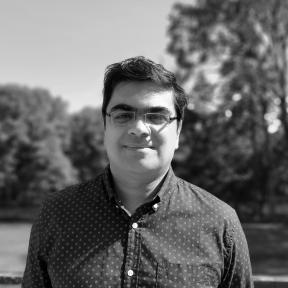
Dr. Waqar Zaidi
Associate Professor and Humanities and Social Sciences Department Chair
Mushtaq Ahmad Gurmani School of Humanities and Social Sciences
e:
Waqar Zaidi is Associate Professor of History at the Department of Humanities and Social Sciences at LUMS. He was recently a Member at the School of Social Science at the Institute for Advanced Study, Princeton, and Verville Fellow at the Smithsonian National Air and Space Museum, Washington, DC. His research focuses on the relationship(s) between technology and international relations in the twentieth century. Current research interests include scientific and technological internationalism, aviation, atomic energy, arms control, and A.I. His first book, titled Technological Internationalism and World Order: Aviation, Atomic Energy, and the Search for International Peace 1920-50, was published with Cambridge University Press in 2021. The book was awarded the 2022 International Committee for the History of Technology (ICOHTEC) Turriano Prize for the best book in the history of technology. The prize committee found that in the book “Zaidi masterfully inscribes top-level history of technology into the most dynamic debates in political history and in the field of International Relations. It is rare that a historian in the early stage of his career can so skillfully contribute to two booming, but too-often-disconnected fields of history of technology and the history of international relations....For its rigour, intellectual bravery and readability, Zaidi’s work is a lighthouse that may illuminate the other researchers’ path.”
Waqar Zaidi has an MSc and PhD in the History of Science, Technology and Medicine from Imperial College London, and a BA(Hons) in Physics from the University of Oxford. He is a Research Affiliate at the Centre for the Governance of A.I. (Oxford), and a Research Collaborator at the Research Institute for the History of Global Arms Transfer, Meiji University. He is also a Vice President of the DHST Historical Commission on Science, Technology and Diplomacy and of the Centre for the Study of Internationalism at Birkbeck College, London. He is also Member of the Editorial Board of the Journal of Transport History and Associate Editor of the interdisciplinary open access journal Palgrave Communications.
At LUMS Waqar teaches a variety of undergraduate courses in global and European history, and in the history of science and technology.
Books
Technological Internationalism and World Order: Aviation, Atomic Energy, and the Search for International Peace 1920-50 (Cambridge University Press, UK, 2021).
Awarded the International Committee for the History of Technology's 2022 Turriano Prize for Best Book.
Journal Special Issue Guest Editorship
(with Marie Huber). Civil Aviation in the Global South. The Journal of Transport History 45(3) Special Issue. (2024).
Journal Articles
“Pakistani Civil Aviation and U.S Aid to Pakistan, 1950-1961”. The Journal of Research Institute for the History of Global Arms Transfer 8, 83-97. (2019). [translated and published in Japanese in: Kaori Takada (ed.), The Century of Aviation: Airmindedness, World Wars, and the Cold War (Tokyo: Nihon Keizai Hyoron Sha, 2020)].
“Convertibility and the Militaristic Perversion of Aviation in Disarmament Discourses, 1919-1945”. The Journal of Research Institute for the History of Global Arms Transfer 5, 19-36. (2018).
“A Blessing in Disguise: Reconstructing International Relations Through Atomic Energy, 1945-1948”. Past and Present 210(6), 309-331. (2011).
Book Chapters
“Liberal Internationalism and the Search for International Peace”. In William M. Knoblauch, Michael Loadenthal, and Christian P Peterson (eds.), A History of World Peace Since 1750 (59-69). London: Routledge. (2018).
“An Historian’s Perspective on Technology and the Cold War”. In Michael R. Fitzgerald and Allen Packwood (eds.), Out of the Cold: The Cold War and Its Legacy (95-100). London: Bloomsbury. (2013).
“David Mitrany and Ernst Haas: Theorising a United Europe”. In Alexander Badenoch and Andreas Fickers (eds.), Europe Materializing: Transnational Infrastructures and the Project of Europe. Basingstoke: Palgrave. (2010).
Working Papers
(with Allan Dafoe). “International Control of Powerful Technology: Lessons from the Baruch Plan for Nuclear Weapons”. Working Paper 2021:9. Centre for the Governance of AI, Future of Humanity Institute, University of Oxford. (2021).
* Media: John Thornhill. “Only scientists and voters can change the politics of catastrophe”, Financial Times (13 May 2021).
Reviews
Review of Fascism, Aviation and Mythical Modernity, by Fernando Esposito. English Historical Review 132(556), 755–757. (2017).
Review of British Nuclear Culture: Official and Unofficial Narratives in the Long Twentieth Century, by Jonathan Hogg. British Journal for the History of Science 49(3), 518-520. (2016).
Review of Cursed Victory: A History of Israel and The Occupied Territories, by Ahron Bregman. Dawn Books and Authors Section. (2014).
Review of The Two Cultures Controversy: Science, Literature and Cultural Politics in Postwar Britain, by Guy Ortolano. The Journal of British Studies 49(1), 220-221. (2010).
Review of Einstein and Eddington, directed by Peter Moffat. Viewpoint: Newsletter of the British Society for the History of Science 88, 11. (2009).
Review of Sky as Frontier: Adventure, Aviation, and Empire, by David T. Courtwright. Aerospace Professional, 23. (2007).
Other Writings
“Technology Divide”. In Sage Encyclopedia of World Poverty 2nd edition (pp. 1524-1527). Thousand Oaks, CA: Sage Publications. (2015).